
Building SriDah: Learning Quant at 50 in the age of LLMs
Building conviction through repeatable research, explainable decisions, and evidence before machine learning.

I went on a career break starting March 1st.
For the first couple of weeks, it was just quiet.
No product roadmaps to tweak, no architecture calls to lead, no customer fires to put out, and no half-baked ideas staring at me from a whiteboard.
For the first time in nearly thirty years, I had nothing but time.
Honestly, it felt amazing for two weeks. Then the stillness started to feel less like freedom and more like emptiness.
One random afternoon, pretty much on a whim, I decided to teach myself quantitative investing.
Zero finance background. No formal training. And absolutely no desire to become some Wall Street trader.
I was just genuinely curious. The idea that you could understand markets not through gut feelings or luck, but through data, evidence, and systems you could actually test and repeat, that fascinated me.
And like most people in tech, I figured I had a head start. I had ChatGPT, Claude, DeepSeek, and Grok all ready to go.
I could generate Python code in minutes, ask the dumbest questions about finance or stats, get machine learning concepts broken down for me, and turn random ideas into working code before my next cup of coffee.
Plus, there was no shortage of open-source tools, like Microsoft’s Qlib, Google’s TF Quant Finance, Backtrader, Zipline, and a bunch more. It honestly felt like the whole playground was already built. I just had to show up and play.

Surely, I thought, the hard part couldn’t be that hard anymore. With LLMs around, I figured they’d fast-track my entire journey into quant investing.
And they did. Just not in the way I expected.
They made building things almost free. Code, backtests, tweaks, all in minutes. But I still had to do the thinking. Took me months to realize that I couldn't just outsource the real work to an LLM. Understanding the domain, knowing which methods actually make sense, figuring out what data to trust, and deciding which approaches are worth pursuing, none of that could be handed over to a bot.
Somewhere along the way, I gave the project a name: SriDah.
What started as a random experiment slowly turned into my research lab, my engineering sandbox, and every now and then, a machine that existed mostly to prove my own ideas were wrong.
Building is easy. Knowing what to build isn’t.
My first instinct was probably the same as everyone else’s.
Find a few indicators, Engineer some features, Train a machine learning model, Backtest it, Optimize the parameters and Repeat.
How difficult this could be? Atleast thats what i thought.
LLMs make this workflow incredibly fast.
They also make it incredibly easy to build sophisticated nonsense.
As the work evolved, every week I continuosly added a new indicator, another score, optimization, model without any success. LLMs kept guiding me based on what i was asking.
Looking back, I wasn’t building a better system. I was building a more complicated one.
It felt like the software kept improving (atleast that’s what i thought).
My understanding didn’t.
One afternoon, after months of work(re), I looked at everything I had built and realized I couldn’t answer one simple question.
Why did this stock get recommended? Not at a high level. Exactly why.
Which signals mattered?
What conditions got triggered?
Which assumptions contributed?
If I couldn’t answer those questions, I had no business thinking about machine learning. That single question changed everything.
SriDah stopped becoming a machine learning project.
Explainability before Intelligence
Most AI projects begin with the model. After all the struggles and failed attempts, SriDah stopped being about the model altogether.
Instead of asking, Can I predict the market?, I started asking much simpler questions.
Can I explain every recommendation?
Can I reproduce every decision?
Can I trace every assumption?
Can I measure whether each assumption actually holds?
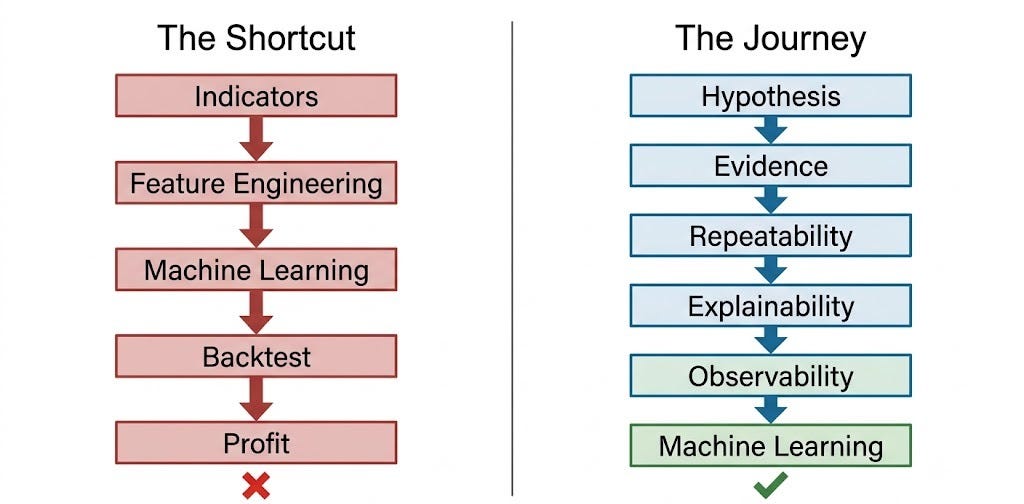
Those questions forced me to slow down.
Explainability came before intelligence.
Repeatability came before optimization.
Machine learning moved from the beginning of the roadmap to the very end.
Ironically, that gave me more confidence that when I eventually (re)build machine learning models, they’ll actually solve the right problem.
Every Alpha begins as a Hypothesis
Reading books like Finding Alphas, Inside the Black Box, From Data to Trade, and Quantitative Trading has helped me understand the basics and how to think.
I used to imagine that successful quantitative investors had discovered secret indicators that everyone else had missed. The reality is much less glamorous.
Every potential alpha starts as a hypothesis.
Momentum persists.
Institutions accumulate over time.
Strong stocks tend to remain strong.
Volume confirms conviction.
None of these are truths. They’re ideas waiting to be challenged.
The job isn’t to prove them right. The job is to collect enough evidence to reject them if they’re wrong.
That sounds obvious. It’s surprisingly difficult in practice.
Because once you’ve spent two weeks building something,
your instinct is to defend it.
Like businesses, the market doesn’t care how much time you’ve invested. It only cares whether you’re right.
One of the hardest skills I’ve had to learn is becoming comfortable throwing away work. Some of my favorite ideas failed completely once I tested them. I’m glad they did.
By the time I wrote this article, I had redesigned/created/updated strategies of SriDah atleast twenty-three times. Every iteration removed another assumption I could no longer defend with evidence.
In retrospect, those redesigns weren't signs of failure. They were evidence that the research was doing exactly what it was supposed to do.
Books tell you what works. Experience teaches you what matters.
The books explain why momentum has historically worked.
Behavioral biases.
Delayed information diffusion.
Institutional constraints.
They’re invaluable. But implementation is where the real education begins.
Questions that look simple become surprisingly difficult.
What exactly is momentum?
Which lookback period?
Which universe?
When has momentum genuinely weakened?
When is a pullback healthy?
When has the original thesis actually broken?
You don’t find those answers in another chapter. Books taught me how successful quantitative investors think. Research papers taught me how they validate those ideas.
Somewhere between the two, I realized that quant isn’t really about finance. It’s applied science operating in one of the most uncertain environments imaginable.
Paper trading validates an algorithm. Real money validates you.
To start with, everyone recommends paper trading. I understand why.
It’s an excellent way to learn platforms and order execution. But after all the attempts, I no longer believe it prepares one for the real world.
Paper trading validates your algorithm. Real money validates your process.
When nothing is at risk, you’re fearless.
You happily sit through drawdowns.
You never hesitate before taking the next trade.
You let winners run.
You patiently wait for losers to recover.
You behave like the disciplined trader you always imagined you’d become.

Then real money enters the equation. A completely different person shows up.
A small drawdown suddenly feels enormous.
You start questioning trades before entering them.
You exit winners too early.
You hold losers because selling makes the loss real.
You begin negotiating with your own rules.
The strategy hasn’t changed. You have. No simulator can teach that lesson.
Drawdowns don’t just test strategies. They test conviction.
One lesson surprised me more than any technical concept.
A strategy can be statistically sound and still make you miserable.
Imagine a strategy with a 60% win rate. Objectively, that’s excellent.
But probability doesn’t guarantee smooth outcomes.
Six or seven consecutive losses are entirely possible.
A month where nothing seems to work is possible.
A prolonged drawdown is possible.
Those periods change the conversation inside your head.
Maybe momentum doesn’t work anymore.
Maybe the market has changed.
Maybe I need another indicator.
Maybe AI can predict better.
Maybe I should redesign everything.
Sometimes change is necessary. Most of the time, it isn’t.
One of the biggest mistake I made wasn’t writing bad code or choosing the wrong indicators. It was assuming every failed idea deserved another chance.
Quant taught me something software engineering rarely forces you to learn.
Being wrong isn’t failure. Refusing to let go of an idea after the evidence says it’s wrong is.
The Unexpected lesson: Observability
This was the biggest surprise of the entire journey. The most valuable thing I built wasnt a
Scanner.
Ranking engine.
Research framework.
It was observability. Originally, I thought observability was an engineering concern.
Log everything.
Track everything.
Measure everything.
Over time I realized it served a very different purpose.
It wasn’t helping me debug software. It was helping me debug myself.
During multiple difficult periods, my confidence was deteriorating much faster than the system itself. Every losing trade felt like evidence that the strategy had stopped working.
The data told a different story. Nothing meaningful had changed.
The hit rate was within historical expectations.
The drawdown was within historical expectations.
The market hadn’t fundamentally changed. Only my confidence had. That realization changed how I thought about research.
Every recommendation became an experiment.
Every experiment produced evidence.
Every piece of evidence either strengthened or weakened a hypothesis.
Instead of asking, Why am I losing money?, I learned to ask better questions.
Has the market regime genuinely shifted?
Has the hit rate actually changed?
Are winners becoming smaller?
Are losses becoming larger?
Or am I simply reacting emotionally to a perfectly normal drawdown?
Observability didn’t eliminate emotions. It prevented emotions from driving decisions.
For me, that became the single biggest advantage of building SriDah.
Most Research should fail
One of the biggest misconceptions about quantitative research is that success comes from discovering brilliant ideas. I’ve found the opposite.
Progress comes from eliminating bad ones.
Most hypotheses should fail.
Most indicators shouldn’t survive validation.
Most intuitively appealing ideas should disappear once they’re measured.
That’s not disappointing. That’s exactly how research is supposed to work.
Every rejected hypothesis makes the remaining ones stronger.
Every failed experiment teaches you where not to look.
Over time, you’re not just building a better system. You’re building better judgment.
Machine learning comes last
Ironically, after spending months learning quant, machine learning is now one of the last items on my roadmap.
Not because I think it’s unimportant. Because I finally understand what it needs.
Reliable data.
Clean labels.
Repeatable processes.
Observable behavior.
Explainable decisions.
Without those foundations, machine learning simply learns your mistakes faster. The model isn’t where the edge comes from.
The edge comes from everything you build before the model.
What building SriDah actually taught me?
When I started this journey, I thought I was building a quantitative platform.
Looking back, I think I was really building a way of thinking.
SriDah became much more than software.
It became a research notebook.
An experimentation platform.
A place where every recommendation became an experiment and every experiment produced evidence. It taught me
How to separate intuition from evidence?
How to design experiments instead of chasing ideas?
How to reject my own assumptions?
How to trust data more than emotions?
LLMs transformed how quickly I could build software. They didn’t change how long it takes to build conviction. That still comes the slow way.
One hypothesis.
One experiment.
One failed idea.
One validated insight.
One at a time.
And perhaps that’s the biggest lesson I’ve learned from building SriDah. The real edge isn’t another indicator or a larger language model or a a more sophisticated machine learning algorithm.
It’s building a process you can still trust after six losing trades, a two-month drawdown, and every instinct telling you to abandon it.
The Road Ahead
I honestly don’t know where this journey of building SriDah will take me.
Will I remain a quasi-quant, spending my time somewhere between software engineering and quantitative research?
Will I eventually become a full-time quant?
Or will I return to building products in the corporate world?
I don’t know.
SriDah is still a work in progress. I have barely scratched the surface. The research continues.
Many of the ideas I’ve explored have been rejected. Many more are yet to be validated.
I’m nowhere near a point where I can confidently call this a success or say it’s ready to become a full-time pursuit. At least, not yet.
But something unexpected has happened along the way. For the first time in a long time,
I genuinely look forward to the next morning.
Every day brings a new idea to explore.
A new hypothesis to validate.
A new research paper to read.
A new experiment to run.
A better way to visualize an idea.
A cleaner way to design a workflow.
A more reliable way to build, test, observe, and learn.
Some days I spend twelve hours building. Other days I spend twelve hours debugging something that looked obvious the night before. And strangely, I enjoy both.
SriDah has become much more than a quantitative investing platform. It’s become a playground for curiosity. A place where software engineering, data, research, behavioral finance, and continuous learning come together.
It has reminded me why I fell in love with building things in the first place.
Will it eventually become a profession?
Maybe. Maybe not.
Right now, I genuinely don’t know and I’m perfectly comfortable with that.
The point is that I’m learning something new every single day, and I’m genuinely enjoying the journey.
Maybe SriDah becomes a product.
Maybe it becomes an investment platform.
Maybe it simply becomes the most interesting thing I’ve ever built.
I’ll leave you with a quote that feels particularly appropriate for this chapter of my life:
“There are no shortcuts to any place worth going.” ~ Beverly Sills
Happy Learning!